Compare
Forestry Mulching or Traditional Land Clearing?
Traditional clearing cuts the trees, grubs out stumps and roots, and hauls or piles the debris. Forestry mulching shreds the vegetation where it stands and leaves roots in place. Both are legitimate, but they set the land up for very different futures.
Get free estimates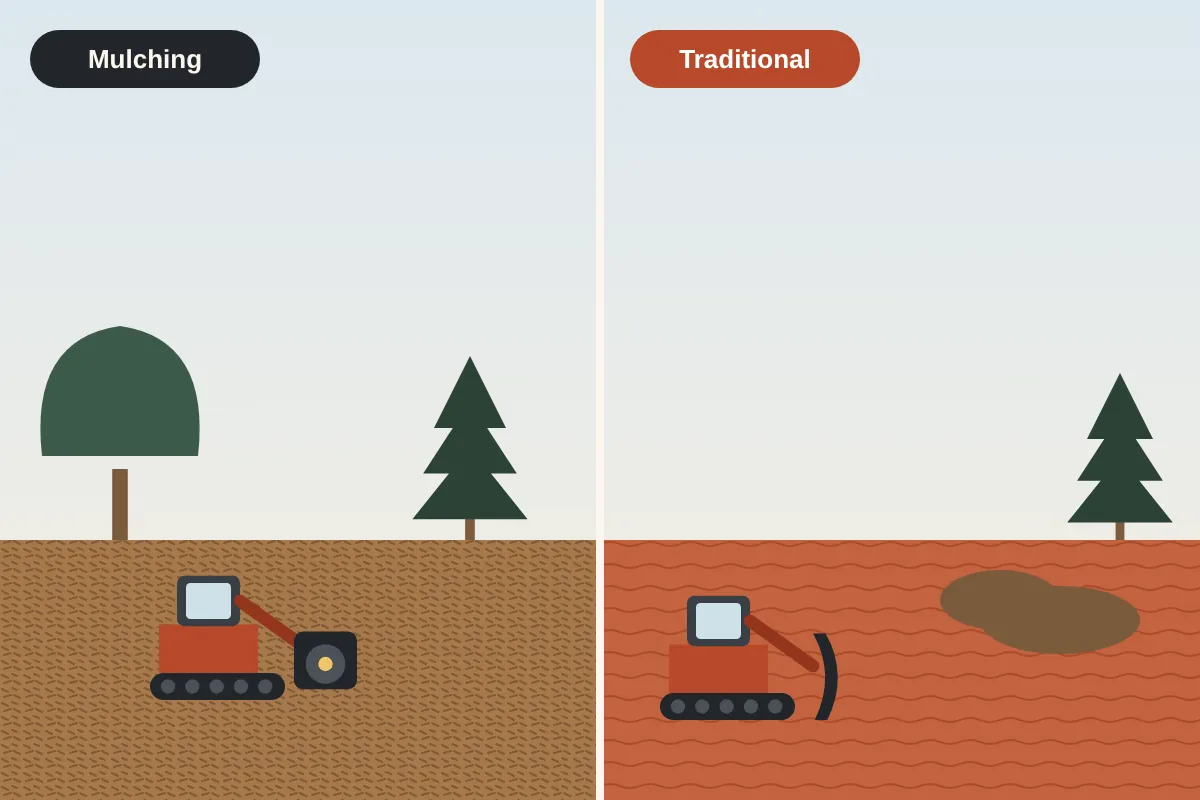
Head to head
| Forestry mulching | Traditional clearing | |
|---|---|---|
| Result | Mulch-covered ground, low stumps | Bare soil ready for grading |
| Roots | Left in the soil | Grubbed out |
| Soil cover | Protected by mulch | Exposed until stabilized |
| Debris | Becomes the mulch layer | Chipped, hauled or piled |
| Trees kept | Easy to work around | Possible, with more care |
| Best for | Understory, trails, pasture, views | Foundations, driveways, ponds, full grading |
Mulching makes sense when
- You're opening woods, not building on them
- The land slopes and you want roots holding the soil
- You'd rather not deal with debris piles or hauling
- Keeping a good share of the trees matters to you
Traditional clearing makes sense when
- A foundation, driveway or outbuilding is going in
- The ground needs reshaping for drainage
- Trees are too large for a mulching head
- You need a clean, root-free surface
Combining them
On many home sites, the smart move is both: traditional clearing and grubbing only where the house, garage and drive will sit, and mulching for the rest of the area being opened up. That limits disturbed soil and debris while still giving your builder a clean site. Ask crews if they offer it and how they'd price it.
A note on debris
Traditional clearing makes a lot of wood. Whether it's chipped, hauled or handled another way is something to settle before work starts. Rules on burning and disposal depend on your town, county and conditions, so check locally and ask the crew how it normally handles debris.
Frequently asked
Which one costs less?
It depends on the land and the result you need. Mulching often wins when debris costs are counted; traditional clearing can be the only option for building areas. Price both if unsure.
Can I build on mulched ground?
The building area usually still needs grubbing and grading. That's why combined approaches are common.
Is mulching better for slopes?
It generally disturbs the soil less, which helps on slopes. Very steep ground may limit any machine.
Related pages
Ready to see your land again?
Describe your land once and we pass it along to clearing crews near you. Free, no obligation.